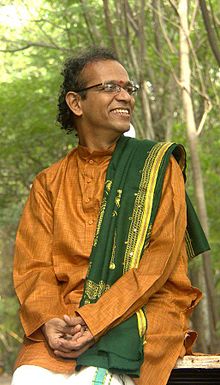
It is a daunting task to introduce an intellectual mammoth such as Dr. Shatavadhani R. Ganesh. What words could possibly encapsulate one whose breadth, depth and soaring height of knowledge is so vast, it is quintessentially all-encompassing.
Anybody who comes in contact with Dr. Ganesh will be in awe of the sheer capacity of the human brain to absorb and retain information on various subjects, in various languages of the world and have it all available at the tip of the tongue, at the snap of a finger. He can explain oblique concepts in the Natya Shastra using chemistry, physics or Shakespeare. Ganesh Sir has a way of making the unrelatable relatable, and by the time we wrap our heads around one profound topic, he would have already made another ground-breaking statement.
It is nearly impossible to verbalize this creative genius whose adherence and commitment to shastra is such that he is one with it. Sitting in Ganesh Sir’s class is akin to being in the presence of Goddess Saraswati herself, who is versed in both para vidya and apara vidya. His eagerness to share without inhibition sees an outpouring of years of study, analysis and experience.
Ganesh Sir kindly agreed to sit with me and answer a few very basic questions that I had regarding the world of art.
- What is art and what is its purpose
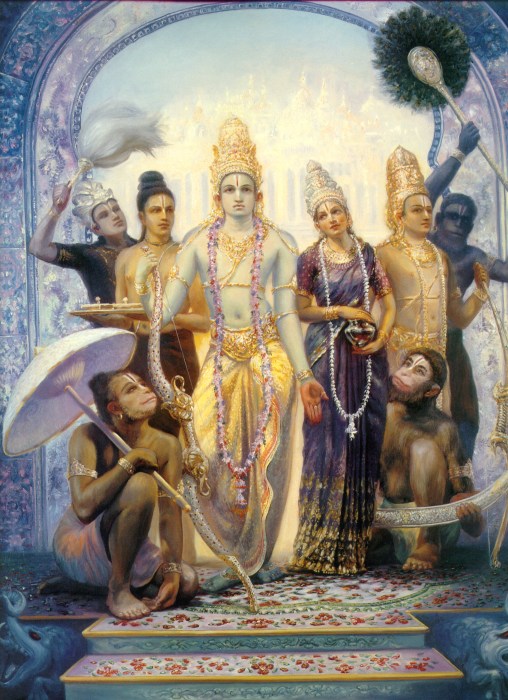
The purpose of art is to transcend all purposes. This is what Professor Hirianna says and I believe in that very much. That is to say, Ananda, is the purpose but not a purpose as such. It is not exclusive. The exclusivity of purposefulness will destroy the beauty of Ananda. And that’s why the purpose of art is ultimately Ananda, which is our very nature, but this is not a separate purpose, it is reveling in one’s true nature. As for the definition of art, art is the product of imagination. Its raw material is human emotion and the end product is a sort of observing our own emotions without involvement, meaning, enjoying our own emotions without involvement. Our emotions are coloured by selfishness as they are centered on ‘I’. Whether it is the love of Rama and Sita, the cruelty of Ravana or the cunningness/shrewdness of Shakuni, all these are present as emotions in all of us. This is the bedrock of Rasa theory. The raw material of rasa is bhava. We must visualize these bhavas at the level of rasa; meaning, if the selfish indulgence is cut off and dispassionate indulgence is restored, what remains is art enjoyment. That is the end product. It is the enjoyment of our own selves without any ignorance.
- How can we extend that state of dispassionate enjoyment into our lives?
Art is a prototype model which can be extended completely into our life. When we watch a film for three and a half hours, we are indulging in that without selfishness. We are compassionate observers. Having no power to change anything there, no mind to grudge or lust for anything, no mind to be indifferent to that, we are simply watching, accepting whatever is shown to us. If the same sense is extended to 24 hours a day, 365 days of the year, then it is the message for life. It becomes art as a path of salvation. It is kala yoga sadhana.
3. How do we perform this sadhana?
We must try to recapture the art experience again and again and re-calibrate our day-to-day experience. We must examine the extent of our indulgence or indifference. Over-indulgence brings a sort of bitterness. Indifference brings another sort of roughness. Both of them have to be curtailed. For that purpose, we have to repeatedly go back to art experience and correct our day-to-day experience. Ultimately speaking: sakshi bhava. Observing a situation as a witness, is what Vedanta says. In art experience, or rasaanubhava, we are doing this without much effort and this very ability to observe a situation objectively has to be extrapolated into our lives.
4. There is always talk of making a work of art relevant to the current time. At the same time, I’ve always felt art, like our emotions, is timeless. From the beginning we have gone through the same sadness, betrayal, separation, love and the like. How do you maintain the integrity of art form and yet have it be relevant?
Relevance, integrity is nothing but devotion to rasa. Expression is vakroti. It is the beautiful expression which depends upon various arts, their grammar and also another property: auchitya. Auchitya is context. The spatio-temporal-cultural-social context. Context may differ, spatio-temporal structures may differ, but human emotions remain the same. Being well rooted in emotions and the technique we have on hand, as well as the context we have around us, art will not go outdated. It will reach, it will touch.
5. Can you please define tradition
Tradition is the critical conservation of the past. It is not something which is blindly and mindlessly accepted, or ruthlessly banished and shunned aside. ‘Conserve,’ means ‘to protect’. ‘Critical,’ is with respect to having an objective mind of analysis of what is good and what is bad. For example, in our tradition, family values are very important. Husband and wife should love and respect each other. If they are fighting day and night for their rights, this does not keep with our value system. In the same way, after the death of the husband, the tradition that the wife should shave her head is simply wrong. Many poets have written, but Kalidasa has written very well, so read Kalidasa first. You can read Vysasa and Valmiki and then Kalidasa. Then move onto Bharavi, Bhaga and Sri Harsha, though compared to them, Kalidasa is better. Finding out the best of the past is critical conservation and that is what should be called ‘tradition’. And that tradition should be perpetuated. All other blind traditions and all other blind anti-tradition movements should not be encouraged.
6. What do you hope to see when you watch a Bharatanatyam performance? What is it that moves you?
I don’t call this ‘Bharatanatyam. It is Sadir or Dasi attam. Bharatanatyam is a Christianized name. All that we are performing in any system, is Bharata’s natya. That is a generic name. With respect to Sadir, the grammar is very incomplete. It is geometric and linear, and not curvilinear. The very nature of Indian art is curvilinear. Look at classical Indian sculpture. Around us we have creepers and branches of trees. And the natural language, Sanskrit, is also oblique and curvilinear. Indian music is another example. Compared to all these, Sadir is more linear because of the domination of tala. In the name of precision, perfection, the strictness of adhering to a system and aramandi- all this has enforced a lot of linearity. If raga is dominant, movement will be curvilinear. So I want its grammar to become less geometrical and more curvilinear, more based on raga. Raga is very rooted in emotions, as compared to tala. Tala is more of an intellectual dimension. So in one word, today’s Sadir is dominated by head. It has to grow more with respect to heart. That is what I can say.
7. What about an artist for whom satva is more dominant and it totally overpowers all these other aspects?
Certainly, satva can do anything. That is a theoretical possibility. But to that level, the artist should pull the audience and for that, introductory angika is needed. All the four are abhinaya. Satva is the pinnacle of all abhinaya. Very close to satva is vachika, then angika and lastly aharya. This is the progression we have. That’s why a dance recital should have very rich music and lyrics. Unfortunately, Bharatanatyam lyrics are very poor compared to Yakshagana or Kuchipudi. Odissi is mainly depending on ashtapadi, which is fantastic, but very restricted. Yakshagana and Kuchipudi lyrics are far richer than the dry, poor pada varnams, thillanas, darus and shabdams. Also, music is made very mathematical in Bharatanatyam. In this way, vachika has lost satva and angika is made very linear, so it has also lost satva. In aharya also, they have not geared for brilliance. Nowadays, they are making a poor show in terms of aharya. For one and a half to two hours the artist should be seen, which means their hands should be seen in a pronounced manner: colour should be there. The face must be well made-up and the body should be covered in jewelry. Poor makeup is not substitute for simplicity. Simplicity should emanate from the heart. Nowadays artists are becoming very arrogant, especially the celebrities. If they try to show simplicity in dress, it is poverty in reality. Dance requires brightness. ‘Ujjwalavesha’, is what Bharata says.
8. When you are exposed to a certain aesthetic such as linearity, for many years, you become conditioned to thinking that only that is beautiful. Curvature does not appeal. Is it right to say that only one is beautiful and the other isn’t when the basis for beauty is in one’s own enjoyment?
The answer is very simple. A straight line is the shortest distance between two points. A line, is a line, is a line; whereas in a curve, there is more variety. There are parabolic curves, hyperbolic curves, helixes, elliptical curves and so on. Variety is more and therefore the scope for creativity is far more. Also, the straight line is very utilitarian. When you look at building structures, wherever there are straight lines, it is for utility and wherever there is embellishment, there are curves. It is not that lines are not beautiful. And it is also not true that just because someone learns the karanas, they are good dancers.
With regard to being pre-conditioned to a certain concept of beauty, well, then, your concept of beauty is biased. You are not looking at it through the objective eyes of shastra. To understand beauty, you need to look at shastra. But to enjoy beauty, you do not need any shastra. You can enjoy anything. Only in a situation of debate or argument do you need the help of shastra. If you need to verbalize why something is beautiful, you must be able to prove it and for that, you need an objective outlook. This comes from study, from going to masters and learning from those who are educated in shastra. It is important not to confuse subjective individual enjoyment and the objective art experience.
9. What advice do you have for those in pursuit of art?
I have no advice. I am the last person to give advice. Be rooted in rasa. Everything else will follow. Enjoy Vyasa, Valmiki and Kalidasa. Enjoy the sculptures of Ellora, Badami and Pattadakal. Enjoy nature, the sunrise, sunset, rain clouds. Enjoy raga. If your enjoyment is honest and intense, that will show you the way.
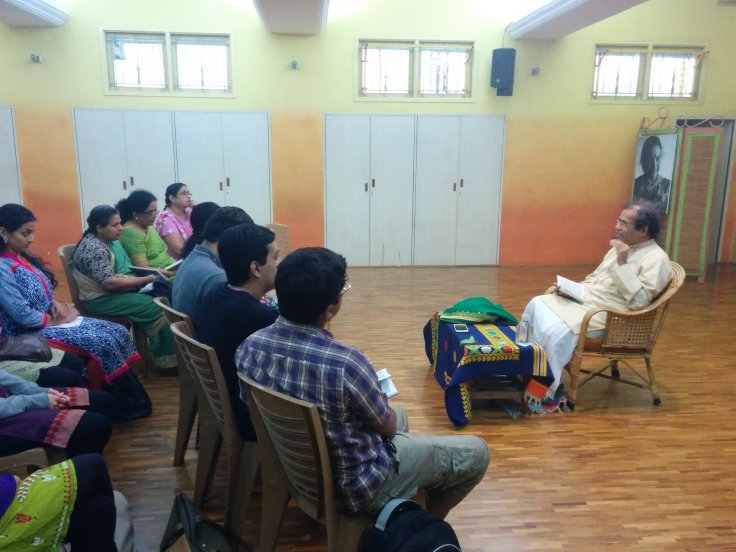
My sincere and heartfelt thanks to Gurus Smt. Nirupama and Sri Rajendra for hosting the wonderful study sessions with Ganesh Sir in their beautiful studio and for making it open to all. It has been a most illuminating, enriching, inspiring and gruelling experience- gruelling in the sense that every time, more fuel is added to the fire of desire to learn more about our epics and gain an insight into what the world has to offer to one who seeks knowledge.
 beneath a banyan
Leave a comment