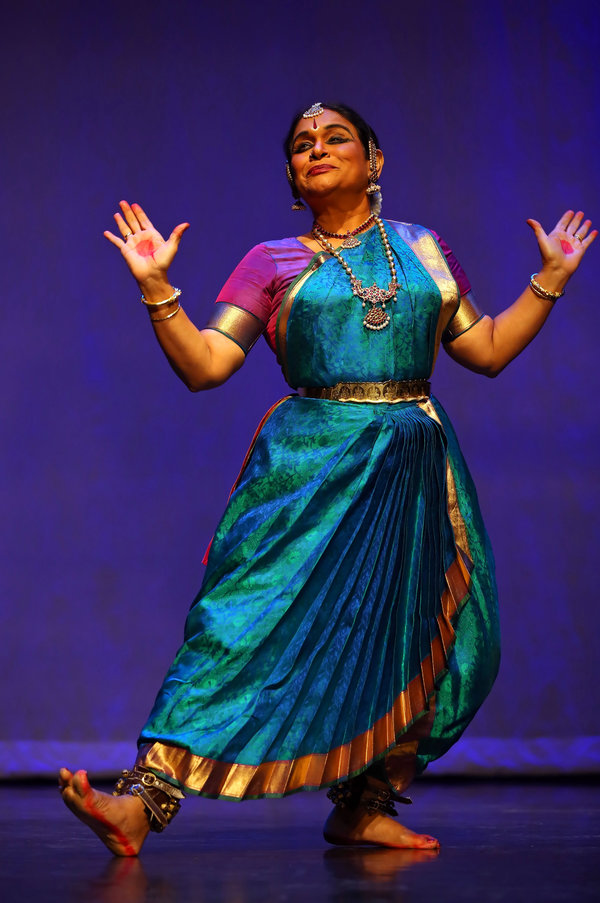
For dancers in Bangalore, the yearly visit of Guru Smt. Bragha Bessel is a much-anticipated event. For one week, we drown ourselves in an ocean of emotion and give expression to feelings we may never have experienced. For this one week, we are forced to tap into the depths of our hearts and bring forth the myriad hues of envy, greed, surrender, mischievousness, flirtatiousness, coyness, childish innocence, sadness of separation or the unbound joy of mutual love. We learn to tread the path of a certain character to such precision, as though walking on a tightrope. The slightest discrepancy in portrayal can send you wobbling off into awkwardness. Balancing and remaining on the sthayi is where the artistry lies and who better to learn from than abhinaya exponent and teacher-extraordinaire, the much-lauded and much-loved, Guru Smt. Bragha Bessel. (A special thanks to Nandini Mehtaji and Murali Mohanji for their dedicated and sustained endeavour of hosting this yearly venture through their organization, Nadam).
Bragha Akka, as she is affectionately called, is a powerhouse of ingenuity, wit and positive energy. Packed into her tiny, cuddly, unassuming frame, is a persona so lovable, she changes the lives of people with her warmth, generosity and tickling humour. As she unfolds an item, careful not to leave out the nuances, we watch; enthralled. Can an art form really be this beautiful? At times, we are rolling on the floor laughing, at times we are in tears and at times, we are simply awe-struck. After all this, each time, we are left with the daunting task of reproducing what we just witnessed- a seemingly impossible feat. But try we must, and with great patience and individual attention, Bragha Akka makes us repeat a single line over and over again until there is some degree of comfort. She spares no effort in delineating the character, situation and the deeper meaning behind the lyrics. Once this is made known, the rest of the time is spent gaining clarity through the various means of portraying each line.
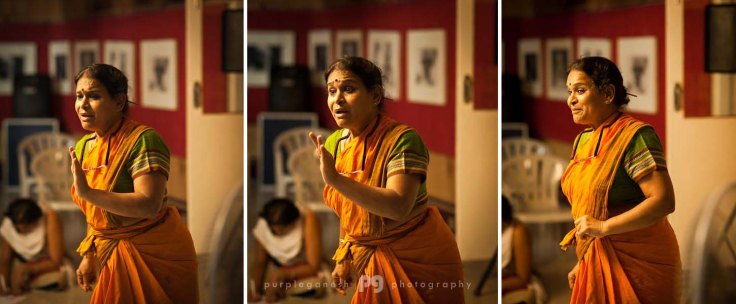
I sat with Bragha akka and asked her a few questions regarding what it is like to teach abhinaya. She recalled her time with Kalanidhi Mami with great fondness and attributes her success to all her Gurus. Here are some excerpts from the interview:
Q: There are some who say that abhinaya cannot be taught. What are your thoughts on this?
A: Only after going to Mami did I understand how much there is to be tapped in a person to involve them in abhinaya. Some people get it very easily, some slowly, some 100%, and some really struggle. It’s a blessing, just as dance is. Some are blessed with theory, some with opportunities, some with abhinaya. Definitely, as teachers, we can help. Some people don’t know what they are dancing. Through my teacher’s training, I can tell how much is buried in a piece. The word-word meaning, general meaning, characterization, what is happening in the piece…by the time one understands the lyrics, one can also understand the characterization.
Some students are shy to emote; they are very conscious of their performance. As a teacher, I can help them cross these small barriers they are scared of. That being said, you need both hands to clap. Students must also be willing to come through that journey. They must work hard with whatever we guide them with. How much more they achieve is in their hands. How deeply or how strongly they take it up is up to them. Abhinaya, as dancing, is again hard work. We can definitely guide them in this and help to tap what is within.
Q: When u look at poem, how do u interpret it? How do u divine the sthayi, character and various bhavas?
A: It’s there in the lyrics itself. When u keep reading lyrics, just the words can tell us what type of girl she is. Let us take for example, Khandita nayika. “Indendu vachati vira”. “Ah, where have u been?” There is immediate sarcasm. Another girl: “Do you need more proof than this?” Again, sarcasm, but a little heightened. “What? Is she more beautiful than me?” Here, there is pride. “Muttavadura”. “Don’t you dare touch me!” There is red anger on him. See, all are angry but they are in different degrees. The lyrics themselves tell us the situation, what has happened, what can happen is in our hands, how we want to finish it. Just keep reading and put your mind in the lyrics. My Veda is the lyric. Every lyric is my Veda.
Q: How do u internalize the character?
A: That comes with anubhavam only. That’s why I said we can teach the child, we can show “Oh here the anger is more. Now you are not showing enough.” You make her understand the situation and stand on the sthayi. Another important thing is only by performing do you get confidence. Only when you get confidence can you swing on that sthayi. That’s why I always tell, wherever there is an opportunity, dance and show. You will get stronger in the subject. By doing more numbers, different songs, dancing more number of times, wherever it may be: temples, associations, Lions Club, anywhere! Face the audience. This is how you get confidence and when u get more confidence, you enjoy landing on the sthayi. Only by anubhavam can you get stronger with your internalization.
Q: When you perform an item, there is an incredible amount of detail which you are able to communicate. I remember when you performed Jagadodharana years ago, you showed Yashoda trying to wake baby Krishna. Yashoda was pulling the blanket and Krishna pulled the blanket back and turned around inside the blanket. We could literally see a small baby pulling the blanket back and rolling around inside. How do you create this visual effect? Do you see it as you are dancing?
A: This detailing I learnt with Kalanidhi Mami. When I joined her, I was in my mid-twenties. I was mad, I was crazy in her subject. Whatever she said, I would do and I enjoyed it and maybe that made me work hard. I used to prepare myself for every class. It would make her very happy and I liked that. Making Mami happy was my grade.
The first thing is feeling the number or character. Then you forget everything else. You are living in the mood of the sthayi. Once you are able to feel the sthayi, the mind gets the precise emotions, the situation and who you are portraying. Once your mind has got it, you don’t have to do anything. The mind will dictate. Then, if it is a blanket Krishna is trying to pull, what is the strength he would use? If it were a silk cloth, it would be different and this will make a difference in your gesture also. But you don’t have to worry about it. Once you feed the sthayi into the mind, you don’t have to worry about it. The mind does the work. That is the most beautiful way because it is just the bhavam. Then you are not there. The characterization is handling it. That is the best way rather than you being there and acting.
So train your mind to be the leader. You become the character. The song determines what you are and you’ve already worked out what you want to interpret and the singer is also there to take you with the flow. That is how I feel. When Hari Prasad sings, he takes each character after that it’s not me. It’s just the song, the bhavam, talam and ambience and beauty of the number. That takes the course.
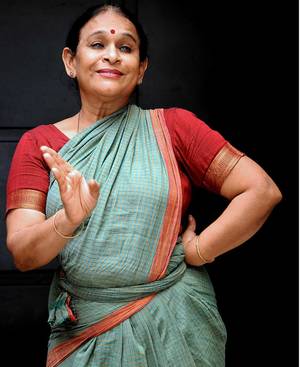
Needless to say, when learning from a master, it feels as though we are being re-invented. We soak-in the spirit, energy and vibrance of the master and they strain out the unwanted thoughts and notions that are inhibiting us from understanding and being able to communicate effectively. Bragha Akka is one such master. She chips away at what is unnecessary and does so with each individual. Though it is a short week, we gain a mountain of information and walk away with a sense of accomplishment and the joy of having something new to work on.
When faced with the task of thanking Bragha Akka at the end of the workshop, all we can really do is bow our heads to her and those before her, in gratitude and surrender.
 beneath a banyan
Leave a comment