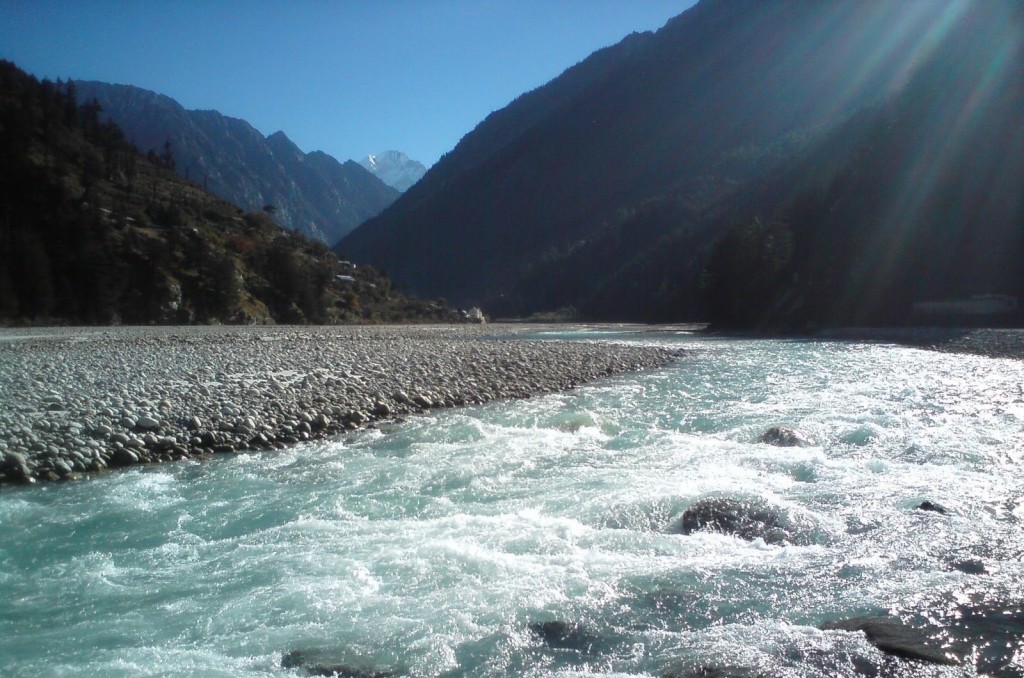
A crisp morning breeze blew through the ashram, carrying Mother Ganga’s whiff. The air was rent with the gurgling gush of Ganga as she cascaded over rocks, her crests rising and falling in crisscrossing oscillations, infusing the atmosphere with a dull cacophony. Set against the backdrop beyond, the mountains loomed ominously, dark mounds etched against the grey sky.
The sun’s first rays peaked above the mountains, piercing the darkness with his jagged spokes before revealing his rotund warmth. As I stood gazing at the glory of nature bedecked with the finery of forests untouched, waters unpolluted (I prefer to idealize), the sonorous chanting of the Vedas and the ringing of temple bells permeated my awareness. Ganga surged with force, as though playing a volatile game of tag with the wind.
Silenced by the beauty of all that was before me, I stood transfixed, enjoying this moment of harmony where thoughts cease to manifest and the invisible line separating the experiencer and the experienced dissolves.
Time and again I chase after this moment, yearning for its finality.
Upon returning to the plane of seer and seen, thinker and thought, I recalled an incidence with Swamiji. He was seated in his reading room, feet propped up on the foot-rest, newspaper in one hand, just setting down his mid-morning cup of tea with the other. Was it just me, or was he always bathed in light? Perhaps it was the orange.
Swamiji used to take his tea warm with a lot of water, just a dash of milk and a pinch of sugar, instead of the piping hot, strong, sugary, milky concoction which is the convention in south India. His coffee too, was similar. As I took the near-empty cup in my hand an old student from the US walked in. I left the room, eager to finish Swamiji’s tea-not for the taste, but for the fact that it was his. I poured the left-over tea into a steel tumbler and proceeded to the sink to wash his cup. Suddenly, Swamiji sent word for me, so I ran. The student had brought some pictures of Rishikesh in the early 1960s and Swamiji wanted me to see them as well. She explained how the photos were taken on a device which was used even before film was invented, and how she had to go to her friend at the Smithsonian museum to get them converted into digital format. They were incredible.
I felt like I was looking at something pre-historic-almost expecting to find a dinosaur’s shadow among the trees. The Rishikesh of today and the Rishikesh of then were worlds apart. The landscape was dotted with trees and shrubs and there was nothing to mark civilization. There were pictures of a few make-shift huts that looked like something right out of the Flintstones and the sadhus looked like they had weathered real storms. Their faces, though marked with lines of trial, had eyes that brimmed with the lustre of a thousand suns. Swamiji was one such who had chosen the hard-knock life, leaving the physical comforts of shelter and timely food to live the life of a renunciate. His grass hut, one of the more spacious dwellings pictured, overlooked the Ganges. For an outsider searching for adventure, it was easy enough to romanticize about the “good old days” before roads and running water, but living in the extremes of frigid winters and scorching summers with naught but a cotton orange robe was not for the faint of heart.
Eyebrows raised, peering through his spectacles, Swamiji scanned the pictures from top to bottom, left to right, not leaving out a single pixel from his one good eye with partial vision. He didn’t say anything for a while, just looked intently at the photos. Finally, he lifted his head and looked at us, adjusted his angavastram with his right hand and placed it behind his ears. In his sonorous voice, completely at leisure, he said, “In those days, the chances of coming across another sadhu, or another person, was rare. If you happened to meet another sadhu, the only words exchanged were ‘Om Namo Narayana.’ That’s it. There was no sadhu-socializing.”
It always took a while for Swamiji’s words to sink in and reveal meaning. The nonchalant way in which he spoke always made them seem deceptively simple, yet everyone knew that Swamiji never spoke an insignificant word, not even in jest. He couldn’t. Vak tapas, he had called it. Slowly, it dawned on me.
Indeed, of what use were relationships to those who revelled in THE relationship?
“I see everything as a vibhuti of Ishwara. You, are a vibhuti. This, is a vibhuti.” Swamiji had once said.
Like pieces of a puzzle coming together, I realized that the moment I had been chasing after time and again was with me at all times, in the very present that I was denying. My regretting the past and worrying about the future were all manifestations of the same reality that I was seeking. So why the chase? Where was the destination? Was it that state of mind of perception without thought? Surely, that could not be the end. It was fleeting and elusive, occurring and passing without notice. What about other states of mind? By experience, they too, were transitory. The answer could not lie in something that was and ceased to be, but in something that is and continues to remain.
As Ganga’s laughter rang in my ears, the weight of the understanding was not lost on me. Every time I stood before her, mesmerized by her beauty, she poked and prodded my subconscious, dusted cobwebs and shed light on dark crevices, unfurling new areas of awareness. Having done her duty, she gave a sly smile and a wink as she hurtled forward effortlessly.
Basking in her glory, a small grin on my face, only one thought remained in my mind: onwards to the present!
 beneath a banyan
Nice article ishu.
LikeLike
Thank you
LikeLike